Hand Drawing Cherry Blossom Branch
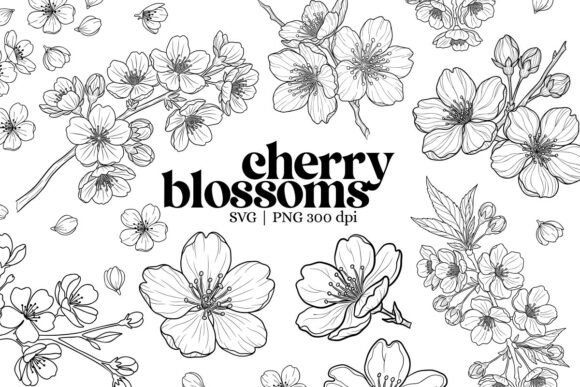
As a designer who’s stitched over 300 custom embroidery projects—from boutique baby onesies to Etsy best-selling tote bags—I opened Hand Drawing Cherry Blossom Branch expecting delicate charm. What I found was something more grounded: a quietly confident illustration that breathes like real sakura—soft but structured, light but legible. It’s not just “pretty.” It’s usable.
A Design That Lands Gently—Not Just Floats
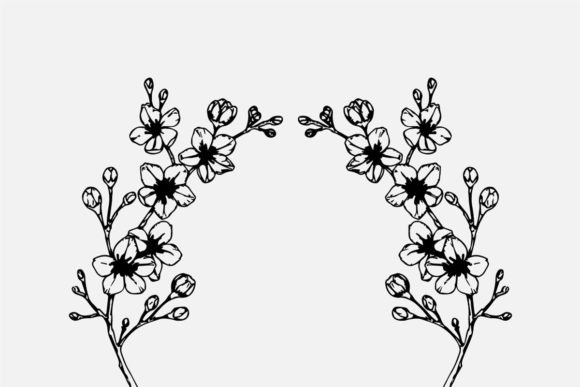
The first thing that struck me wasn’t the petals—it was the branch. It has weight and direction, with subtle tapering and natural curvature. That matters when you’re hooping a curved surface like a cap or a pillow cover. Unlike many cherry blossom graphics that dissolve into airy abstraction, this one holds its shape across scales. The falling petals aren’t scattered randomly; they follow gentle arcs, giving motion without chaos. And the flowers? They’re spaced with breathing room—no overcrowding, no visual fatigue. That’s gold for embroidery.
I immediately pictured it on a linen tea towel for a spring kitchen collection—centered, modest in scale, with raw-edge hemming. Or as a single-side chest embroidery on an organic cotton sweatshirt for a small-batch apparel line. It doesn’t scream. It invites. That’s rare in an era of oversaturated floral designs.
Where It Shines in Real Embroidery Projects
Custom apparel: On midweight cotton or fleece, Hand Drawing Cherry Blossom Branch reads cleanly at 3.5–4.5 inches wide. The branch stem gives strong anchor points for satin stitch definition, while the petals translate beautifully into soft fill stitch gradients—especially with matte rayon or cotton thread.
Baby items & nursery decor: I tested a scaled-down version (3") on a bamboo-cotton blend onesie. With light tear-away stabilizer and reduced stitch density in petal areas, it stayed soft and washable—no stiff patches or puckering. Parents notice that. They feel it.
Embroidered patches & aprons: As an appliqué design or standalone motif, it holds up well on twill or denim. The isolated elements (petals, buds, branch tip) make it easy to crop or reposition—ideal for asymmetrical apron pockets or side-embroidered tote bags.
Holiday & gift-ready pieces: Paired with minimalist typography (“Spring 2025” or a monogram), it elevates personalized gifts without looking trendy or dated. I used it on a set of embroidered pillow covers for a bridal shower—guests commented on how “calm” and “intentional” the design felt, not just decorative.
Where to Proceed Thoughtfully
This isn’t a one-size-fits-all embroidery file. Its quiet elegance means it needs thoughtful context:
- Small hoop sizes (under 4"): Trim the outermost falling petals if needed—the core branch and 2–3 blooms carry the motif’s identity.
- Textured or stretchy fabrics: Use cutaway + topping combo on knits or terry cloth. Petals can blur on high-pile towels unless stitch density is adjusted.
- Dark fabric: Test white or ecru thread on black linen first. Some petal edges soften visually—enhance them with a fine running stitch outline if clarity is critical.
- Curved surfaces (caps, mugs, curved pillow fronts): Avoid placing the longest branch axis directly over the crown seam. Rotate slightly to follow the curve.
- Frequent-wash items (baby clothes, kitchen towels): Confirm stitch density isn’t too low in thin petal areas—under-stitched sections may fray over time.
What It Adds to Your Finished Product—Beyond Aesthetics
Hand Drawing Cherry Blossom Branch subtly raises perceived value. It reads as handmade—not mass-produced clip art. That builds trust with customers browsing your Etsy shop or boutique shelf. When buyers see intentional negative space, balanced asymmetry, and botanical accuracy (not generic “flower”), they assume care went into the whole process—not just the stitching.
It also supports brand consistency. Whether you sell embroidered tea towels, baby blankets, or custom caps, this design feels cohesive across categories—not because it’s repetitive, but because it carries the same quiet confidence. And for digital product sellers: as a Graphics asset, it works seamlessly in printable mockups—clean vector lines hold up in PNG previews, and the isolated elements make it easy to layer with text or other illustrations.
Practical Designer Notes Before You Stitch
Before committing to a client project or production run:
- Test on scrap fabric matching your final substrate—especially for nap, stretch, or sheen.
- Check thread color contrast in both natural and artificial light. Sakura pink reads differently on oat vs. charcoal.
- Review stitch density in petal clusters—some vector-to-embroidery conversions overfill delicate shapes.
- Confirm hoop size compatibility. If your machine maxes out at 4x4", decide early whether to simplify or resize.
- Inspect tiny details: bud tips, petal veining, branch texture. Do they survive digitization? Zoom in on your embroidery software preview.
- Try black-and-white mockups. Does the silhouette still read as cherry blossom—or just “a branch with blobs”?
- Compare light/dark background renders. Does it retain personality on both?
- Use appropriate stabilizer: tear-away for stable wovens, cutaway for knits, topping for textured surfaces.
- Verify licensing terms before selling finished products or bundling as part of a digital embroidery file pack.
Bottom line? Hand Drawing Cherry Blossom Branch isn’t flashy—but it’s reliable, expressive, and deeply rooted in craft sensibility. It belongs in the toolkit of anyone making embroidered patches, sweatshirt designs, personalized gifts, or small shop merchandise where authenticity matters more than volume. It’s the kind of Illustrations asset that doesn’t shout for attention—it earns it, stitch by thoughtful stitch.