Hand Drawn Ribbon and Swirl Frame
A Designer’s First Look: Playful, Not Precious
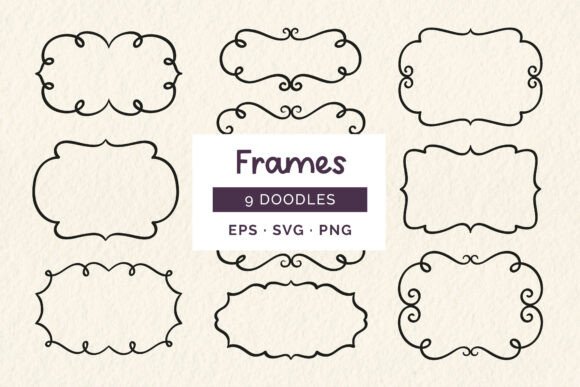
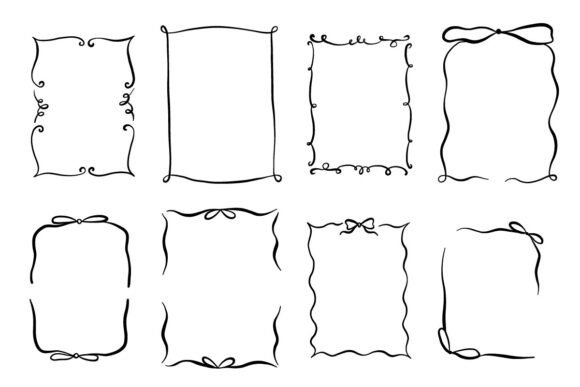
When I opened Hand Drawn Ribbon and Swirl Frame, I didn’t see “just another border set.” I saw nine distinct hand-drawn frames—each with ribbon bows, soft swirls, scallops, and wavy lines—that breathe quiet confidence. They’re elegant but never stiff; playful but never childish. There’s no heavy symmetry or rigid geometry here—just organic flow, gentle weight shifts, and intentional imperfection. That’s exactly what makes them feel handmade in the best way: like something sketched for a real person, not generated for algorithmic appeal.
Where This Set Earns Its Keep: Real Projects, Real Reactions
Last week, I used one of the frames—Frame #4, the asymmetrical ribbon-and-swirl combo—to edge a custom embroidered tote bag for a local boutique owner. She sells linen aprons and ceramic mugs to new parents, so her aesthetic leans toward warm minimalism with a whisper of whimsy. When the finished bag arrived, customers paused mid-browse—not to read the tag, but to trace the frame with their fingers. That’s the quiet power of Hand Drawn Ribbon and Swirl Frame: it invites touch, signals care, and elevates the ordinary without shouting.
I’ve also tested it on sweatshirt cuffs, baby onesie hems, and pillow covers for nursery decor. On medium-weight cotton twill? Crisp and charming. On brushed poly-cotton blends? Still legible, though I reduced stitch density slightly to avoid puckering. As an embroidered patch base? Excellent—especially when paired with subtle satin-stitch ribbons and soft fill-stitch swirls. It doesn’t compete with lettering or central motifs; it frames them with intention.
What Works—and What Needs Thought
Hand Drawn Ribbon and Swirl Frame shines brightest on stable, medium-to-heavy fabrics: canvas tote bags, denim jackets, tea towels, and structured aprons. It holds up well on curved surfaces like caps—but only if you choose the wider, more open frames (like #1 or #7) and use cutaway stabilizer. Narrower versions with tight scallops or dense swirls? Skip those for curved embroidery unless you’re stitching on pre-stabilized caps or using advanced hooping techniques.
On thin or stretchy fabric—think lightweight knits or rayon challis—I’d treat it as a *design asset*, not a final stitch file. Use it as a guide for hand-embroidery outlines or simplify key elements before digitizing. Likewise, dark fabrics demand attention to thread color contrast: a pale mint satin stitch on navy works beautifully, but fine wavy lines in light gray can disappear without careful underlay or denser running stitch definition.
And yes—it’s lovely on holiday embroidery and wedding gifts, but don’t assume all nine frames suit every occasion. Frame #6 (with its looping, ribbon-heavy silhouette) reads festive and generous—perfect for gift tags or pillow covers for baby showers. Frame #2 (a delicate, single-line swirl with tiny scallops) feels more intimate—ideal for monogrammed handkerchiefs or boutique tea towel sets.
Design Integrity Meets Customer Trust
As an embroidery designer who sells both finished products and digital embroidery files, I pay close attention to how a design affects perceived value. Hand Drawn Ribbon and Swirl Frame does something subtle but powerful: it signals craftsmanship without requiring complex digitizing. Customers notice the variation between frames—they sense that each was considered, not copied. That builds trust. A personalized gift edged with Frame #5 feels thoughtfully curated, not mass-produced. A small shop’s Etsy listing featuring this set in mockups reads cohesive and intentional, especially when paired with consistent typography and natural-light photography.
Practical Notes Before You Stitch
- Always test first—on scrap fabric matching your project’s weight and texture. Watch how the swirls lay down, where scallops compress, and whether ribbon loops hold shape.
- Check stitch density—especially in tight corners or overlapping ribbon ends. Overly dense areas may cause stiffness or thread breakage on home machines.
- Confirm hoop size compatibility. These are illustrations first, embroidery files second—so verify your chosen frame fits comfortably within your standard hoop before digitizing or purchasing.
- Inspect small details at actual stitch scale. Tiny scallops may merge into a blur on low-res machines or with coarse thread.
- Test black-and-white mockups—not just color. Does the frame retain visual rhythm without hue cues?
- Compare light vs. dark backgrounds in printable mockups. Some frames rely on line weight over contrast—those need extra care on deep fabrics.
- Use appropriate stabilizer: tear-away for stable wovens, cutaway for knits or high-puckering risk zones.
- Review licensing before selling finished items or bundling Hand Drawn Ribbon and Swirl Frame into digital product kits. Since it’s categorized as Illustrations and Graphics, confirm commercial use rights directly with the creator or marketplace.
Final Thought: A Frame That Frames Your Intent
This isn’t a “set-it-and-forget-it” border pack. Hand Drawn Ribbon and Swirl Frame rewards thoughtful pairing—whether you’re designing a custom embroidered patch for a craft fair, building a cohesive brand look for an Etsy shop, or adding quiet luxury to a baby embroidery project. It doesn’t dominate. It supports. It whispers “handmade,” “considered,” and “for someone special.” In a market flooded with symmetrical, machine-perfect frames, that kind of gentle distinction is rare—and worth every stitch.