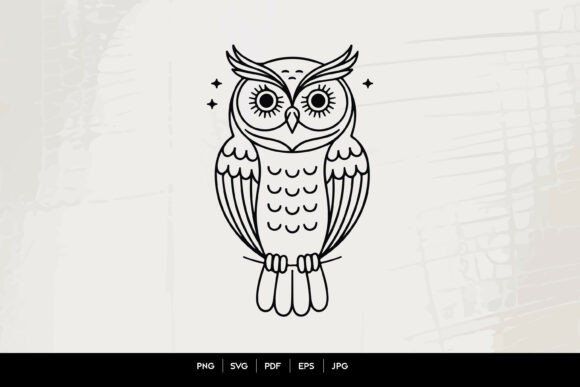
Cute Owl Line Art SVG
First Impression: Simple, Sweet, and Surprisingly Versatile
Opening the Cute Owl Line Art SVG files felt like unrolling a quiet sketchbook page—clean, confident, and intentionally uncluttered. This isn’t a busy illustration or a heavily textured character; it’s a hand-drawn owl outline with gentle curves, soft eyes, and a subtle asymmetry that reads as warm, not sloppy. The line weight stays consistent across formats (SVG, EPS, PNG, JPG, PDF), which tells me the vector foundation is solid—not just traced from a raster image. As an embroidery designer who’s stitched hundreds of animal motifs, I immediately saw its potential: not as a statement piece demanding attention, but as a quiet signature—ideal for baby onesies, linen tea towels, or minimalist tote bags meant to age gracefully.
Real Project Test: Embroidering It on a Linen-Cotton Kitchen Towel
I pulled out a 12” x 16” natural linen-cotton blend towel—the kind popular in small-batch kitchen boutiques—and hooped it with medium-weight cutaway stabilizer. At 3.5” wide, the Cute Owl Line Art SVG scaled cleanly without distortion. Using a running stitch (not satin or fill), I kept the design light and breathable—perfect for a fabric that gets washed weekly. The result? A tactile, slightly rustic owl that looked handmade without looking amateurish. Customers browsing my Etsy shop wouldn’t mistake it for clipart; they’d see intention. That’s the difference between decoration and detail.
Where It Shines (and Where It Needs Care)
- Custom apparel: Works beautifully on sweatshirts and structured cotton tees—especially when placed left-chest or on a sleeve cuff. The clean lines translate well to dense knit fabrics if you reduce stitch density slightly and use tear-away + topping.
- Baby embroidery: Ideal for onesies, burp cloths, and nursery pillows. Its simplicity avoids overwhelming tiny garments, and the open shapes minimize thread buildup—critical for delicate skin.
- Embroidered patches: Trace the outline cleanly onto twill or denim backing. Because it’s a true line art design (no interior fills), it stitches quickly and presses flat—no puckering at the edges.
- Holiday & gift items: Paired with a simple “Owl-mas” or “Hoot & Happy” text in a matching font, it adds charm to holiday stockings or personalized mugs (via printable mockups).
- Small shop branding: Use the SVG version to create cohesive labels, tags, or even a subtle watermark on digital product previews—reinforcing your craft business identity without shouting.
Use With Intention—Not Assumption
This isn’t a one-size-fits-all embroidery file. Its strength lies in restraint, so don’t force it where complexity belongs. Avoid using Cute Owl Line Art SVG on:
- Curved surfaces like caps or beanies unless you test hoop placement first—thin lines can distort on tight curves;
- Ultra-thin fabrics (like voile or chiffon) without additional stabilizer—fine details may sink or blur;
- Dark fabrics with light thread unless you verify contrast in a black-and-white mockup first;
- Products requiring frequent heavy washing (e.g., kids’ backpacks) without testing stitch durability—running stitch holds up well, but always check seam integrity;
- Commercial embroidery projects where clients expect dense, dimensional results—this is line art, not applique design.
What It Adds to Your Finished Product (Beyond the Stitch)
Stitching the Cute Owl Line Art SVG doesn’t just add imagery—it adds tone. On a handmade apron? It whispers “thoughtful craft,” not “mass-produced.” On a personalized baby blanket? It feels like a lullaby in thread. That quiet confidence builds customer trust: buyers sense the design was chosen, not dropped in. For Etsy sellers and boutique owners, that translates directly to perceived value and repeat engagement. It also plays nicely with brand consistency—if your shop leans into organic textures, muted palettes, or slow-made aesthetics, this owl fits right in, no rebranding needed.
Practical Designer Notes Before You Stitch
- Always test Cute Owl Line Art SVG on scrap fabric matching your final project’s weight and stretch;
- Review thread color contrast—especially if stitching on heathered or dark fabric;
- Confirm hoop size compatibility: while the vector scales cleanly, very small versions (<2”) may lose clarity in stitch execution;
- Inspect corners and eye details at actual stitch size—some line art flattens in conversion to embroidery file;
- Try a black-and-white printable mockup first to assess balance and scale against your product layout;
- Use appropriate stabilizer: cutaway for knits, tear-away for stable wovens, topping for napped fabrics;
- Verify licensing terms before selling finished embroidered goods or bundling the design as part of a digital product—this Cute Owl Line Art SVG includes multiple formats, but commercial use rights aren’t implied by format alone;
- Remember: as an Illustrations asset, its power lies in adaptability—not automatic readiness. Treat it like raw material, not a plug-in solution.
Final Thought: Less Is More—When It’s Done Right
The Cute Owl Line Art SVG won’t wow with flash—but it earns respect through reliability. It’s the kind of design that looks better after five washes than it did on day one, that invites touch instead of distance, and that quietly elevates a handmade product from “nice” to “I want to know who made this.” Whether you’re prepping for a craft fair, building an Etsy collection, or designing custom gifts for local clients, this owl doesn’t shout. It settles in—and that’s exactly why it works.