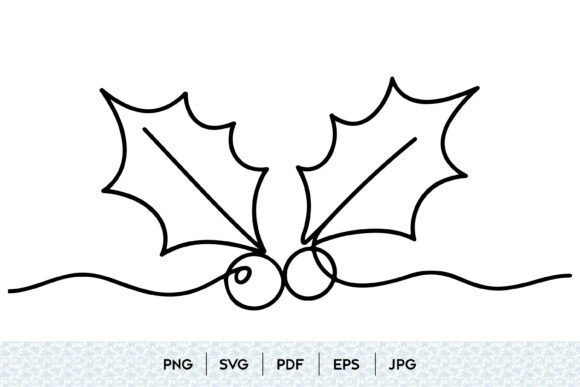
Christmas Holly Berry Line Art SVG
A Clean, Festive Silhouette That Stitches With Quiet Confidence
As someone who’s stitched holly motifs on everything from organic cotton baby onesies to heavyweight denim aprons, my first impression of the Christmas Holly Berry Line Art SVG was immediate: it breathes. Not busy, not fussy—just a single, confident line tracing a classic holly sprig with three leaves and clustered berries. There’s no shading, no gradients, no decorative flourishes. Just rhythm, balance, and intention. It feels like a hand-drawn sketch translated into vector precision—ideal for embroidery where clarity matters more than complexity.
Where This Design Naturally Lands (and Why It Sells)
I recently used the Christmas Holly Berry Line Art SVG as the centerpiece for a set of linen tea towels for a local boutique. The simplicity meant it stitched cleanly at 3.2" wide—even on textured, loosely woven fabric—and read instantly as “holiday,” without shouting. Customers responded to its quiet elegance: one buyer told me she chose it over busier designs because “it looked handmade, not mass-produced.” That’s the sweet spot. This isn’t a design for maximalist holiday sweaters or glitter-heavy Instagram reels. It’s for the embroidered patch on a wool cap, the subtle corner motif on a baby blanket, the minimalist tote bag for a small-batch coffee roaster’s holiday collection.
It performs especially well in contexts where restraint reads as sophistication: nursery decor, wedding guest favors (think linen napkins), personalized kitchen towels, and unisex sweatshirt embroidery. Because it’s line art—not a filled illustration—it translates beautifully into running stitch or satin stitch outlines, making it flexible for both delicate heirloom work and bold, graphic apparel.
What Works—and What Needs Thoughtful Handling
The Christmas Holly Berry Line Art SVG shines on stable, medium-weight fabrics: cotton twill, brushed poly-cotton, midweight linen, and even some fleece-backed sweatshirts. On those surfaces, the clean lines hold their shape, corners stay sharp, and berry clusters remain distinct—not blobby—after stitching.
But real-world embroidery means real-world compromises. Here’s where I pause:
- Small hoop sizes (under 4”): The design fits comfortably, but test stitch the leaf tips—they’re fine points that can fray or skip if tension is off or stabilizer is insufficient.
- Stretchy or thin fabrics (like jersey or voile): Use cutaway stabilizer, not tear-away. The line weight is light enough that puckering will distort the silhouette.
- Dark or textured backgrounds: It reads best with high-contrast thread (e.g., bright red berries + deep green leaves on cream or oatmeal fabric). Avoid matching thread colors—this design relies on definition, not blending.
- Curved surfaces (caps, mugs, curved pillow covers): Resize carefully. Shrinking below 2.5" risks losing the visual weight of the stem and leaf junctions. Enlarging beyond 5" may require re-digitizing for optimal stitch flow—this file is optimized for flat, centered placement.
How It Elevates Your Finished Product—Beyond Just Looks
When customers see this kind of intentional minimalism on a handmade product, they don’t just register “holly.” They register care. Thought. A designer who understood the medium—not just the motif. That perception lifts perceived value: a $28 embroidered tea towel feels like a keepsake, not a seasonal throwaway. For Etsy sellers, that translates directly to fewer returns, higher review scores, and repeat buyers asking for “more designs like this.”
It also supports brand consistency. If your craft business leans into earthy, modern, or Scandinavian-inspired aesthetics, the Christmas Holly Berry Line Art SVG slots in seamlessly—no rebranding needed. And because it’s versatile across formats (SVG, PNG, EPS, JPG, PDF), you can use the same asset for digital mockups, packaging labels, social media banners, and physical embroidery—reducing creative fragmentation.
Practical Designer Notes Before You Stitch
Before committing to a full production run—or listing your finished item—I always do these six things with any new embroidery file:
- Test the Christmas Holly Berry Line Art SVG on scrap fabric that matches your final substrate—same weave, weight, and stretch.
- Run a black-and-white mockup first. Does the line weight hold up? Are berries legible at your intended size?
- Check thread color contrast on both light and dark fabric swatches—not just on screen.
- Verify hoop size compatibility. Even though it’s line art, tight curves need room to stabilize.
- Inspect small details at 200% zoom: leaf serrations, stem taper, berry spacing. If those feel vague in the vector, they’ll read as muddy when stitched.
- Confirm licensing terms—especially if you plan to sell finished embroidered items commercially or resell digitized versions. This is an Illustrations-category Graphics file, so usage rights matter for your craft business model.
One last note: this isn’t a “set and forget” embroidery file. Its strength lies in how thoughtfully you apply it—not how many features it has. Use it where subtlety wins. Where craftsmanship speaks louder than clutter. Where a single holly sprig says everything you want your brand to say this season.