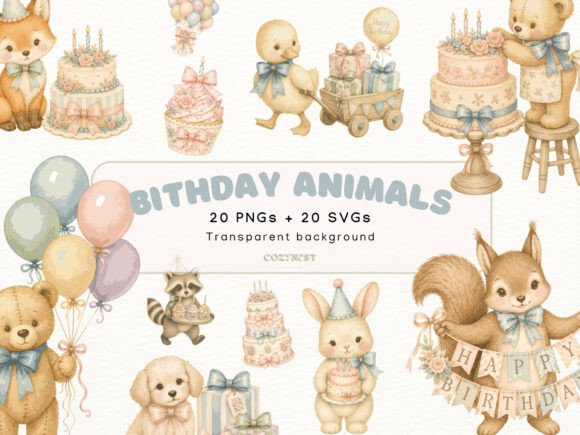
Birthday Animals Watercolor Cliparts SVG
First Impressions: Storybook Charm, Not Just Pretty Pixels
Opening the Birthday Animals Watercolor Cliparts SVG bundle feels like flipping open a well-loved nursery book—soft edges, gentle pigment bleed, and animals that look like they’ve just stepped out of a lullaby. This isn’t bold vector line art or hyper-clean digital illustration. It’s intentionally imperfect: watercolor textures whisper across each animal’s fur, whiskers, and birthday hats. As an embroidery designer who’s stitched hundreds of clipart-based files, I immediately ask: *Will this translate to thread without turning muddy?* The answer hinges on restraint—and knowing where it belongs.
A Real Project Test: Embroidering a Keepsake Baby Tote Bag
Last week, I used one of the fox designs from the Birthday Animals Watercolor Cliparts SVG collection to embroider a cotton canvas tote for a newborn gift. The goal wasn’t novelty—it was heirloom softness. I chose the 4.5" version (scaled down from the original), placed it centered on the front panel, and stitched with matte cotton thread in warm taupe and blush. What surprised me wasn’t how sweet it looked—but how *legible* it stayed at that size. The watercolor effect translated into subtle satin stitch gradients, not chaotic fill stitches. No detail vanished; the fox’s ear curve, tiny bow, and paw pads all held shape. Customers notice that difference—the kind that makes someone pause at a craft fair booth and say, “That looks handmade, not printed.”
Where It Shines (and Where It Asks for Thought)
The Birthday Animals Watercolor Cliparts SVG excels in projects where warmth and quiet personality matter more than sharp precision:
- Embroidered baby items—onesies, burp cloths, and blanket corners—where softness reads as care;
- Tote bags and tea towels for boutique shops or Etsy listings, especially when paired with minimalist typography;
- Pillow covers and nursery wall hangings, where the watercolor mood supports a cohesive, calming aesthetic;
- Custom sweatshirt embroidery for small-batch kids’ apparel brands aiming for storybook authenticity, not cartoon flash;
- Embroidered patches (heat-applied or sewn-on) for camp gear, backpacks, or school uniforms—its gentle scale avoids visual overload.
Cases That Demand Extra Caution
This isn’t a one-size-fits-all machine embroidery design. Its charm lives in its subtlety—so it needs thoughtful handling:
- Small hoop sizes under 3": Fine details like whiskers or cake candles may collapse into noise. Scale down only if your digitizer has simplified versions—or test first.
- Stretchy or thin fabrics (like jersey or lightweight rayon): The watercolor texture relies on even tension. Use cutaway stabilizer + basting spray, and avoid high-stitch-density areas near seams.
- Dark fabric backgrounds: Those soft washes won’t pop unless you add a white underlay or choose thread colors with enough contrast. Always preview in black-and-white mockups before stitching.
- Curved surfaces like caps or beanies: The organic shapes work beautifully—but avoid placing delicate elements (e.g., balloon strings or tiny stars) directly over seams or crowns where distortion occurs.
- Frequent-wash items (baby bibs, kitchen towels): Confirm thread colorfastness and stitch density. Overly dense fill stitches can stiffen fabric; lighter satin or running stitch accents often read truer to the watercolor spirit.
What It Adds to Your Finished Product—Beyond Aesthetics
Using the Birthday Animals Watercolor Cliparts SVG does more than decorate—it shifts perception. On an Etsy listing, it signals intentionality: this isn’t mass-produced clipart; it’s curated design assets with emotional resonance. For a small shop owner selling personalized gifts, it elevates perceived value—customers pay more for “hand-drawn feel” even when it’s digitally stitched. And for craft business branding? It quietly reinforces consistency: whether you’re selling embroidered tea towels or printable mockups for other designers, this style becomes part of your visual voice.
Practical Designer Notes Before You Stitch
Before committing to a client project or bulk production:
- Test on scrap fabric first—especially with your exact thread brand and stabilizer combo. Watercolor illusions live or die by thread sheen and tension.
- Review stitch density. If the file includes multiple layers (e.g., base wash + detail lines), check whether your machine handles layer transitions smoothly.
- Confirm licensing terms. Since this is categorized as Illustrations and Graphics, verify whether commercial use of finished embroidered products is permitted—and whether resale of the digital embroidery file itself is allowed.
- Inspect small details at actual stitch-out size: tiny eyes, bow loops, candle flames. If they vanish or blur, simplify or re-digitize selectively.
- Compare light vs. dark background mockups. What reads as gentle on ivory linen may disappear on navy denim.
- Use proper stabilizer: medium-weight cutaway for structured items (totes, aprons); tear-away for lightweight cottons (pillow covers, onesies).
Final Thought: It’s Not Just Clipart—It’s a Design Decision
The Birthday Animals Watercolor Cliparts SVG won’t suit every embroidery project—and that’s its strength. It invites curation. When you choose it, you’re choosing a mood, a pace, a kind of quiet celebration. It works because it doesn’t shout. It fits best on things people hold close: baby blankets, teacher appreciation gifts, boutique totes passed hand-to-hand at farmers markets. In a world of oversaturated designs, this bundle earns trust—not with volume, but with voice. Stitch it right, and what you deliver isn’t just a custom apparel piece or embroidered patch. You deliver a feeling—childhood magic, gently stitched.