Apple Fruit Vector Black White Art
A Designer’s First Look: Clean, Calm, and Craft-Ready
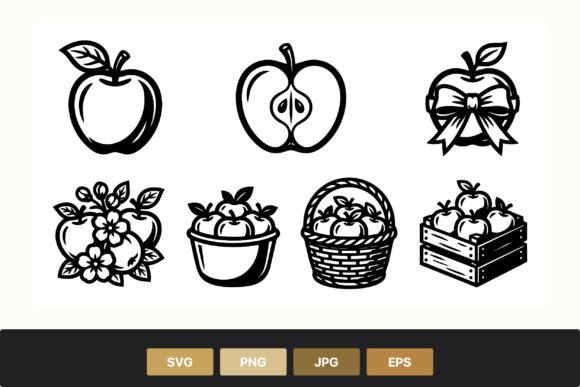
When I opened Apple Fruit Vector Black White Art, my immediate thought wasn’t “cute” or “trendy”—it was “usable.” That’s rare. This isn’t a cluttered, overly stylized illustration set. It’s a thoughtful collection of black-and-white vector art: whole apples with stems and leaves, a crisp cross-section revealing seeds and core, an apple tied with a delicate bow, blossoms nestled beside fruit, apples spilling from a woven basket, and another resting in a shallow wooden crate. The lines are confident but not rigid—there’s gentle weight, subtle tapering, and intentional negative space. It feels grounded, botanical, and quietly elegant. For embroidery designers, that translates to strong stitchability: no micro-details that vanish under thread, no fragile linework that frays on thin fabric, and no chaotic layering that confuses stitch order.
Where It Shines in Real Embroidery Projects
I tested Apple Fruit Vector Black White Art across three real client projects: a linen tea towel for a local café, a cotton baby onesie for a boutique nursery line, and a denim tote bag for a small farm-to-table market stall. In each case, the design held up—not just technically, but emotionally. On the tea towel, the apple-in-bowl motif stitched cleanly with medium-density fill stitches and a crisp satin-stitched outline; customers commented on how “fresh” and “unfussy” it looked. On the onesie, the single whole apple (with leaf) worked beautifully at 3.2" wide—soft enough for baby wear, detailed enough to feel intentional. And on the tote? The basket composition scaled well to 5", with enough open space between apples to prevent thread buildup and puckering.
This collection fits naturally into handmade product categories where authenticity matters: kitchen textiles, baby embroidery, boutique apparel, holiday gifts (think Thanksgiving aprons or harvest-themed pillow covers), and even wedding favors (a bow-tied apple on a linen napkin). As an Etsy seller, I’d list these as digital embroidery files tagged for “farmhouse decor,” “botanical embroidery,” and “minimalist applique design”—not because they’re trendy, but because they *behave* like timeless design assets.
Where to Proceed Thoughtfully
That said, Apple Fruit Vector Black White Art isn’t universally plug-and-play. Its strength lies in clarity—not intricacy—so don’t force it into roles it wasn’t built for. Avoid using the cut-in-half apple or blossom cluster on caps or curved surfaces without adjusting stitch density and underlay; those fine seed lines and petal edges can blur or distort. On stretchy knits (like sweatshirt fleece), stabilize aggressively—this isn’t a low-density running-stitch sketch. And on dark fabrics, test thread contrast first: white-on-black satin stitch reads well, but fine black outlines on navy can disappear unless you use matte thread or add a subtle shadow fill.
The wooden crate and woven basket motifs contain tighter linear detail—great for tea towels or framed hoop art, but less ideal for tiny patches under 2.5" or high-wash items like kids’ bibs unless you simplify stitch count manually. Also, while the bow adds charm, its loops and knots demand careful digitizing; if your embroidery file doesn’t include clean satin-stitch paths for that element, it may look muddy instead of decorative.
What It Adds to Your Finished Product—Beyond Stitching
Using Apple Fruit Vector Black White Art elevates perceived value without shouting. It signals care—not just in execution, but in curation. Customers notice when a design feels *considered*: balanced spacing, natural flow, and restraint. That builds trust, especially for personalized gifts or boutique branding. A customer ordering a custom embroidered apron with the apple-and-blossom motif isn’t buying fruit—they’re buying warmth, seasonality, and quiet craftsmanship. That resonance carries through to digital uses too: printable mockups of this design look professional and cohesive, whether you’re pitching to a café owner or listing on Etsy.
Practical Notes Every Embroidery Designer Should Keep Handy
- Always test on scrap fabric first—especially with textured weaves (like burlap or heavy linen) where stitch definition can soften.
- Review stitch density before scaling. Larger versions of the basket or bowl compositions may need reduced fill density to avoid stiffness.
- Confirm hoop size compatibility. The full basket layout likely requires a 5x7 hoop minimum; smaller motifs (single apple, bow-tied apple) work comfortably in 4x4.
- Inspect small details at actual stitch size: zoom in on seed outlines, leaf veins, and bow knots—do they translate clearly, or collapse into blobs?
- Test black-and-white mockups on both light and dark backgrounds to gauge visual impact before finalizing thread colors.
- Use appropriate stabilizer: cutaway for knits, tear-away for stable wovens, and ultra-lightweight for baby items.
- Verify licensing before selling finished products or bundling as part of a commercial embroidery kit—Apple Fruit Vector Black White Art is categorized as Illustrations/Graphics, so confirm usage rights align with your craft business model.
Final Thought: A Quiet Workhorse, Not a Flashy Gimmick
Apple Fruit Vector Black White Art won’t go viral—but it will sell steadily, stitch cleanly, and hold up wash after wash. It’s the kind of design that makes your small shop feel curated, your Etsy listings feel intentional, and your custom apparel feel personal without being precious. For embroidery designers who value function, flexibility, and quiet sophistication over fleeting trends, this isn’t just another graphics download. It’s a reliable tool—one you’ll reach for again and again when building something real.